Amy Pasquinelli
Research
The discovery that regulatory RNAs control almost every biological pathway has revolutionized our understanding of gene expression. At the forefront, microRNAs (miRNAs) have proven to be an abundant and essential class of RNA molecules in plants and animals. The numerous examples of defects in specific miRNA pathways contributing to complex diseases, including cancer, heart ailments and neuronal pathologies highlights the importance of these regulatory RNAs in human biology. The overall goal of the Pasquinelli Lab research program is to understand how miRNA-mediated regulation of gene expression contributes to organismal development and viability. We have primarily used C. elegans as a model animal system to investigate how miRNAs are expressed and regulate gene expression in an endogenous context. The pathways we study are broadly conserved throughout animal phylogeny and relevant to understanding the role of miRNAs in human development and disease.
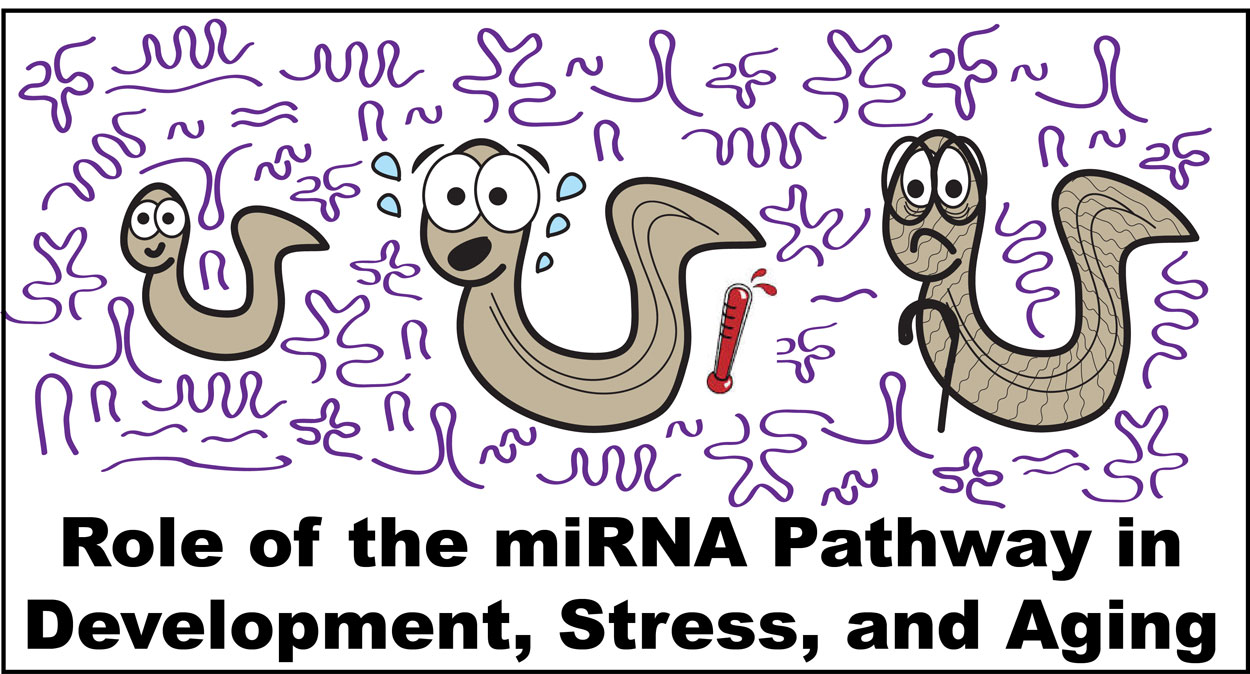
A daunting challenge in the miRNA field is to establish biological functions for the thousands of miRNAs that have been discovered across species. While some miRNAs have proven to play essential roles in animal development, behavior, and viability, deficiencies in many other miRNAs appear to have no obvious consequences in worm or mouse knockout models. One explanation for these findings is that some miRNAs might only be needed in particular contexts, such as stress, that organisms regularly experience in the wild, but not in the laboratory. We use a combination of genetics, genomics, molecular biology and biochemistry to understand how the miRNA pathway responds to and regulates gene expression changes needed for an organism to survive environmental assaults, like high heat.
Another context where the miRNA pathway plays a key role is during organismal aging. MiRNAs depend on Argonaute (AGO) proteins to bind and regulate the expression of target genes at the post-transcriptional level. Surprisingly, we found that two AGOs play opposing roles in aging C. elegans. Loss of AGO Like Gene 1 (ALG-1) results in a shortened lifespan, while loss of ALG-2 leads to an extended lifespan. To understand the basis for these opposing longevity functions, we aim to identify the miRNAs, targets, tissues and aging pathways involved.
Select Publications
- Pagliuso DC, Bodas DM, Pasquinelli AE. Recovery from Heat Shock Requires the MicroRNA Pathway in Caenorhabditis elegans. PLoS Genetics. 2021Aug 5;17(8):e1009734. doi: 10.1371/journal.pgen.1009734. eCollection 2021 Aug.PMID: 34351906 PMCID: PMC8370650
- Garrigues JM, Tsu BV, Daugherty MD, Pasquinelli AE. Diversification of the Caenorhabditis heat shock response by Helitron transposable elements. Elife. 2019 Dec 11;8. pii: e51139. doi: 10.7554/eLife.51139. PMID:31825311 PMCID: PMC6927752
- Schreiner WP, Pagliuso DC, Garrigues JM, Chen JS, Aalto AP, Pasquinelli AE. Remodeling of the Caenorhabditis elegans non-coding RNA transcriptome by heat shock. Nucleic Acids Res. 2019 Oct 10;47(18):9829-9841. doi: 10.1093/nar/gkz693. PMCID: PMC6765114
- Aalto AP, Nicastro IA, Broughton JP, Chipman LB, Schreiner WP, Chen JS, Pasquinelli AE. Opposing roles of microRNA Argonautes during Caenorhabditis elegans aging . PLoS Genet. 2018 Jun 21;14(6):e1007379. doi: 10.1371/journal.pgen.1007379. eCollection 2018 Jun. PMCID: PMC6013023
- Azoubel Lima S, Chipman LB, Nicholson AL, Chen YH, Yee BA, Yeo GW, Coller J, Pasquinelli AE. Short Poly(A) Tails are a Conserved Feature of Highly Expressed Genes. Nat Struct Mol Biol, 2017 Dec;24(12):1057-1063. doi: 10.1038/nsmb.3499. Epub 2017 Nov 6. PMCID: PMC5877826
- Broughton JP, Lovci MT, Huang JL, Yeo GW, Pasquinelli AE. Pairing Beyond the Seed Supports MicroRNA Targeting Specificity. Mol Cell, 2016 Oct 20:64:1-14.
Biography
Amy Pasquinelli received her Ph.D. in Biomolecular Chemistry from the University of Wisconsin-Madison and was a Helen Hay Whitney Postdoctoral Fellow in the Genetics Department at Harvard Medical School. Since joining the faculty in 2003, she has been named a Keck Distinguished Young Scholar in Medical Research, a Searle Scholar, a V Foundation for Cancer Research Scholar, an Emerald Foundation Scholar and a Rosalind Franklin Young Investigator.