Learn more about the study of Animal Behavior at UCSD.
Keep up to date with the lastest activities and events! Please join The Teaching Bee groups on Facebook, YouTube, and ResearchGate. 


Predators such as Asian hornets have likely engaged in an evolutionary arms race with prey such Asian honey bees. The hornet are large and have exceptionally thick armor that bee stings penetrate with difficulty. Honey bees have evolved heat-balling, which takes advantage of their ability to recruit large number of nest defenders to swarm around the hornet and kill it with heat and elevated carbon dioxide levels. However, this is a costly defense, and, as such, one expects the evolution of warning signals. In fact, Asian bee species have evolved a fascinating wing flicking display, the "I See You" (ISY) signal that warns the hornet it has been detected. This type of warning is part of broad category of alarm signals found in many types of animals and part of what we studying in China. Why is the ISY signal effective? Is it truly an honest signal? Under certain circumstances, can "bluffing" be a useful strategy for animals like bees?
Lab news
Adrian Fisher II, Rafaela Tadei, May Berenbaum, James Nieh, Harry Siviter, James Crall, Jordan R. Glass, Felicity Muth, Ling-Hsiu Liao, Kirsten Traynor, Nicole DesJardins, Roberta Nocelli, Noa Simon-Delso, Jon F. Harrison (2023) Breaking the cycle: Reforming pesticide regulation to protect pollinators. Bioscience 0:1-6. https://doi.org/10.1093/biosci/biad088
Hendriksma H, Hsiung KK, Bell HC, and Nieh JC. (2023) Aggression between invasive hymenopterans in Southern California: scutellata-hybrids versus German yellowjackets. Journal of Apicultural Research. DOI 10.1080/00218839.2023.2270870
Dong S, Lin T, Nieh JC, and Tan K (2023) How to study signal learning of the waggle dance in honey bees (Apis mellifera). Bio-Protocol 13(16): e4789. DOI: 10.21769/BioProtoc.4789
Zarate D, Mukogawa B, Kohn J, Nieh JC (2023) Seasonal variation in defense behavior in European and scutellata-hybrid honey bees (Apis mellifera) in Southern California. Scientific Reports 13:12790. https://doi.org/10.1038/s41598-023-38153-2
Dong S, Li J, Wang Z, Tan, K, Yang M, and Nieh JC (2023) Social collapse arising from allopatric hornet attacks. Entomologia Generalis. DOI: 10.1127/entomologia/2023/1825
Dong S, Lin T, Nieh JC, and Tan K (2023) Dong S, Gaoying G, Lin T, Tan K, Nieh (2023) An inhibitory signal associated with danger reduces honey bee dopamine”. Current Biology. https://doi.org/10.1016/j.cub.2023.03.072
Honey bee don’t care (apologies to honey badger don’t care)
Dong S, Lin T, Nieh JC, and Tan K (2023) Social signal learning of the waggle dance in honey bees. Science. 379: 1015-1018. https://science.org/10.1126/science.ade1702
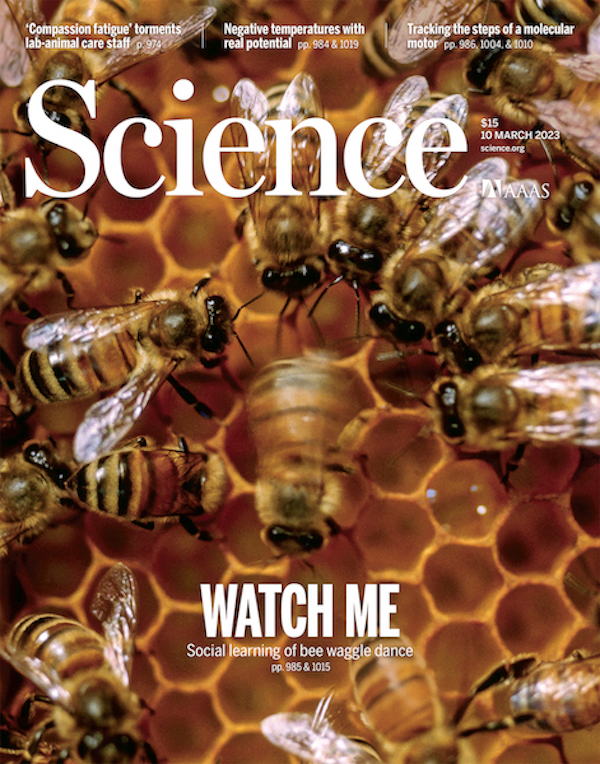
Honey bees can improve their waggle dancing via social learning.
This video from Science provides more information about the paper.
This video provides more information about the paper.
Dong S, Sun A, Tan K, and Nieh** JC (2022) Identification of giant hornet, Vespa mandarinia, queen sex pheromone components. Current Biology. 32(5): R211-R212 https://doi.org/10.1016/j.cub.2022.01.065
Here, you can see a male hornet mating with a tethered female hornet
James CC, Sánchez D, Cruz-López L, Nieh, JC (2022) Fighting ability and the toxicity of raiding pheromone in an obligate kleptoparasite, the stingless bee Lestrimelitta niitkib. Behavioral Ecology and Sociobiology. 76:38. https://doi.org/10.1007/s00265-022-03129-1.
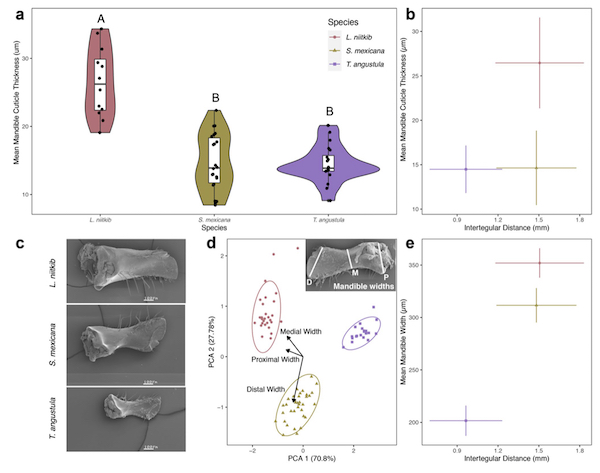
The obligate robber bee, Lestrimelitta niitkib, has mandibles with thick cuticles that may help it in biting attacks against victim species. In additon, its raiding pheromone may act as a toxin to paralyze victim bees .
Bell H, Hsiung K, Pasberg P, Broccard FD, Nieh JC (2021) Responsiveness to inhibitory signals changes as a function of colony size in honey bees (Apis mellifera). Journal of the Royal Society Interface. 18. 20210570. https://doi.org/10.1098/rsif.2021.0570.
Please see the official UCSD Press Release about this paper and this public summary written by author Heather Broccard-Bell: "Does size matter? Lessons from studying signaling in honey bee colonies"
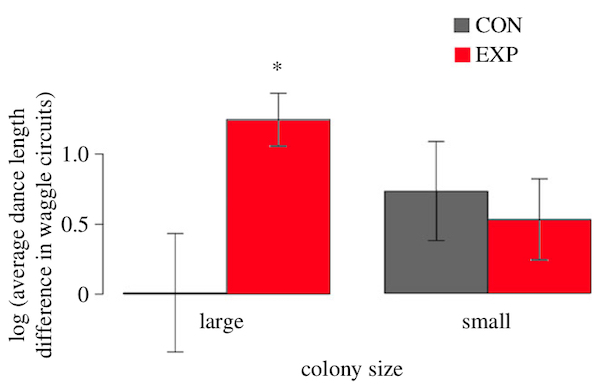
Large honey bee colonies are more responsive to inhibitory stop signals than smaller colonies.
Fisher A, Berenbaum M, Crall J, DesJardins N, Glass J, Harrison J, Liao L-H, Muth F, Nieh J, Nocelli R, Simon-Delso N, Siviter H, Tadei R, Traynor* K (2021) Reform pesticide regulations to protect pollinators. Nature Correspondence.
Tosi S, Nieh JC, Brandt A, San Martin G, Colli M, Fourrier J, Giffard H, Hernández-López, Malagnini V, Williams GR, Simon-Delso (2021) Long-term field-realistic exposure to a next-generation pesticide, flupyradifurone, impairs honey bee behaviour and survival. Communications Biology. 4: 805 https://doi.org/10.1038/s42003-021-02336-2
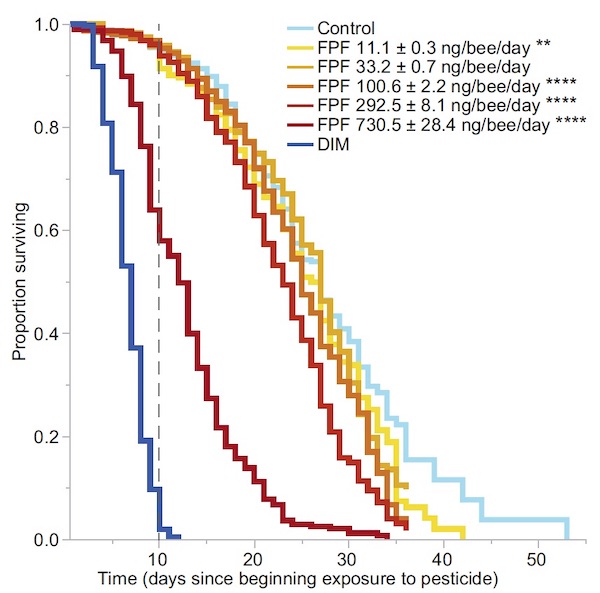
Effects of adult lifetime exposure to the pesticide, flupyradifurone, on worker bee survival. Results of a multi-national study.
Meng, Y., Mo, X., He, T., Wen, X., Nieh, J.C, Yang, X., Tan, K., New bioactive peptides from the venom gland of social hornet Vespa velutina, Toxicon, https://doi.org/10.1016/j.toxicon.2021.06.002.
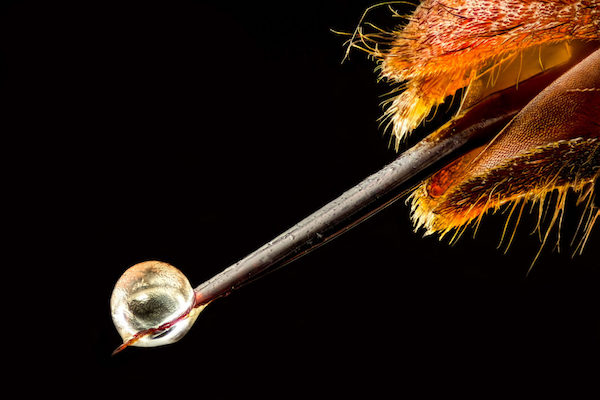
Venom from the invasive hornet, Vespa velutina contains compounds that have antibiotic properties against common, problematic bacteria.
Gaoying G, Meng Y, Tan K, Dong, S, and Nieh JC (2021) Lethality of honey bee stings to heavily armored hornets. Biology. 10: 484.https://doi.org/10.3390/biology10060484 PMID: 3407 2577
Rittschof and Nieh, J. C. Honey robbing: could human alterations to the environment change a rare foraging tactic into a maladaptive behavior? (2021) Current Opinion in Insect Science. 45:84-90. https://doi.org/10.1016/j.cois.2021.02.005.
Gong Z, Dong S, Wang Y, Tan K, and Nieh JC (2021) Floral tea polyphenols can improve honey bee memory retention and olfactory sensitivity. Journal of Insect Physiology. 128: 104177. https://doi.org/10.1016/j.jinsphys.2020.104177
Dong S, Tan K, Nieh JC (2020) Visual contagion in prey defense signals can enhance honest defense. Journal of Animal Ecology. 00:11-8. http://dx.doi.org/10.1111/1365-2656.13390.
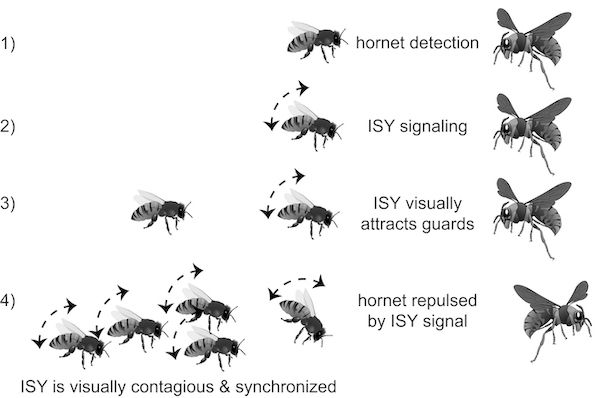
Asian honey bees provide an "I See You" signal that wards off hornets, but only if there are a sufficient number of signalers. It turns out that this ISY signal is visually contagious and can attract other guard bees to the attack site and also causes them to synchronously produce the ISY signal, even when no hornet is visible. The bees have safeguards against the runaway spread of false signals.
The following news articles have been published in the media based upon the ISY signal paper by Dong et al. (2020) Please download this zipped file for the pdf files.
Wu YY, Pasberg P, Diao QY, Nieh JC (2021) Flupyradifurone reduces nectar consumption and foraging but does not alter honey bee recruitment dancing. Ecotoxicology and Environmental Safety. 207, 111268, DOI 10.1016/j.ecoenv.2020.111268.
Hendriksma, H. P., Bain, J.A., Nguyen, N., and Nieh JC. (2019) Nicotine does not reduce Nosema ceranae infection in honey bees. Insectes Sociaux. https://doi.org/10.1007/s00040-020-00758-5.
Ludicke JC, and Nieh JC (2019) Thiamethoxam impairs honey bee visual learning, alters decision times, and increases abnormal behaviors. Ecotoxicology and Environmental Safety. 193, 110367.
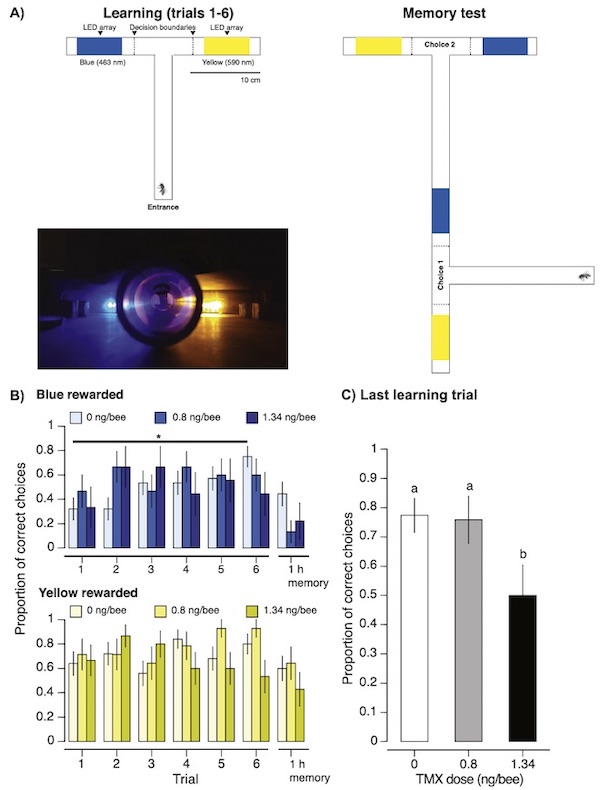
The pesticide, thiamethoxam, can increase honey bee abnormal behaviors and decrease their ability to visually learn.
Kheradmand, B., and Nieh, J. C. (2019) The role of landscapes and landmarks in bee navigation: a review. Insects. 10, 342, doi:10.3390/insects10100342.
Bell HC, Benavides J, Montgomery CM, Navratil JRE, and Nieh JC (2019) The novel butenolide pesticide flupyradifurone (Sivanto®) does not alter responsiveness to sucrose at either acute or chronic short-term field-realistic doses in the honey bee, Apis mellifera. Pest Management Science. https://doi.org/10.1002/ps.5554.
Tong, L, Nieh, JC, Tosi, S. (2019) Combined nutritional stress and a new systemic pesticide (flupyradifurone, Sivanto®) reduce bee survival, food consumption, flight success, and thermoregulation. Chemosphere. 237: 12448. https://www.sciencedirect.com/science/article/pii/S0045653519316297?via%3Dihub.
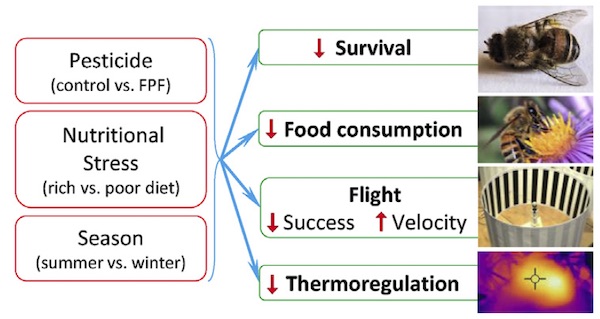
The pesticide, Sivanto®, can reduce bee lifespan and the ability of bees to fly.
Gong Z., Tan K., and Nieh J.C. (2019) Hornets possess long-lasting olfactory memories. Journal of Experimental Biology. 222, jeb200881. doi:10.1242/jeb.200881.
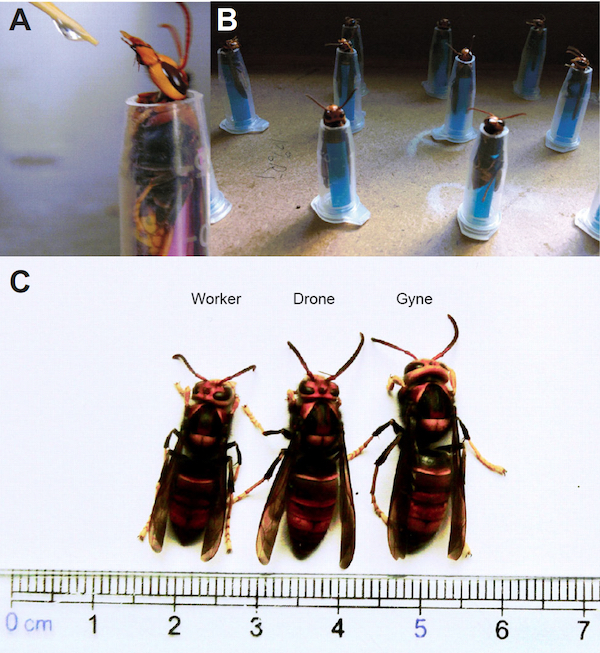
The hornet, Vespa velutina, has long-lasting olfactory memory that can persist at least up to 30 d in gynes and drones. This image shows how we harness the hornets for olfactory learning and the different castes that were tested.
Hendriksma H.P., Pachow, C.D. and Nieh, J.C. (2019) Effects of essential amino acid supplementation to promote honey bee gland and muscle development in cages and colonies. Journal of Insect Physiology 117: 103906.
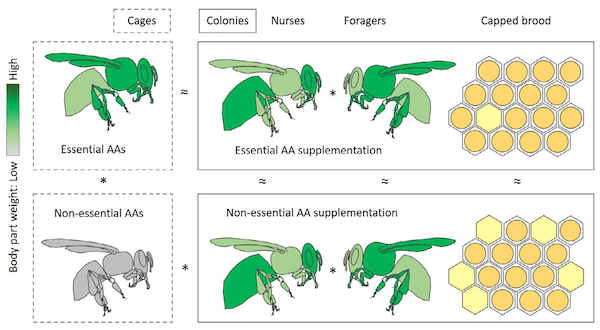
Supplementing honey bees with essential amino acids can increase the weight of nurse bee heads (site of brood food glands) in caged bee studies. In full field colonies, an increase in nurse bee body weight corresponded to a significantly higher number of capped brood cells, a measure of colony productivity and fitness.
Tosi, S. and Nieh, J.C. (2019) Lethal and sublethal synergistic effects of a new systemic pesticide, flupyradifurone (Sivanto®) on honey bees. Proceedings of the Royal Society B. 286: 20190433. http://dx.doi.org/10.1098/rspb.2019.0433
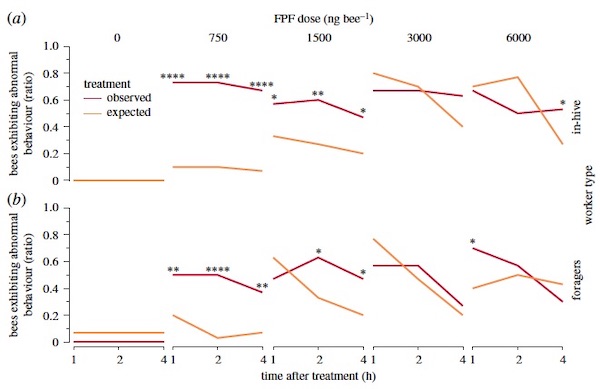
A recently developed pesticide, flupyradifurone (Sivanto), can interact with a common fungicide (propiconazole) to synergistically decrease survival and synergistically increase abnormal behaviors in honey bees. In the video below, you can see some of the abnormal bee behaviors caused by exposure to flupyradifurone and propiconazole.
The following news articles have been published in the media based upon the Sivanto (flypyradifurone) pesticide exposure paper by Tosi and Nieh (2019). Please download this zipped file for the pdf files.
The official UCSD Press Release about this paper is also available.
Andrey Rubanov, Kaleigh A. Russell, Jason A. Rothman, James C. Nieh, and Quinn S. McFrederick (2019) Intensity of Nosema ceranae infection is associated with specific honey bee gut bacteria but not overall gut microbiome structure. Scientific Reports. 9:3820 | https://doi.org/10.1038/s41598-019-40347-6
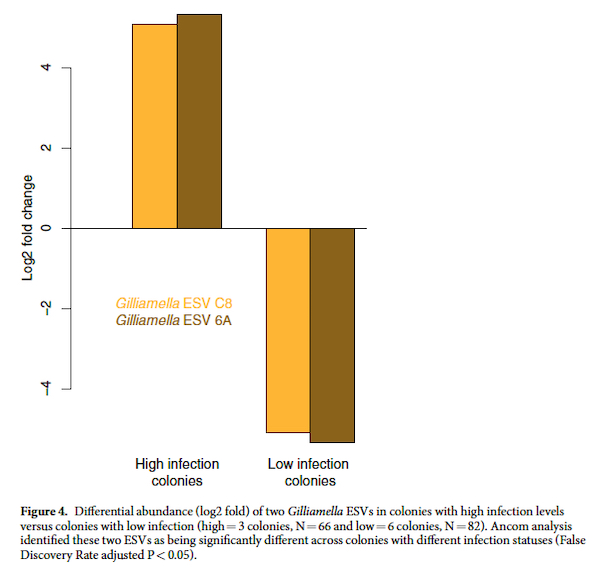
A common honey bee disease, Nosema ceranae, can subtly, but significantly alter the gut microbiome of the European honey bee, Apis mellifera. In this graph, you can see the differential abundance of two Gilliamella ESV's in colonies with high vs. lower Nosema infection levels.
Dong S., Tan K., Zhang Q., and Nieh J.C. (2019) Playbacks of Asian honey bee stop signals demonstrate referential inhibitory communication. Animal Behaviour. 148: 29-37
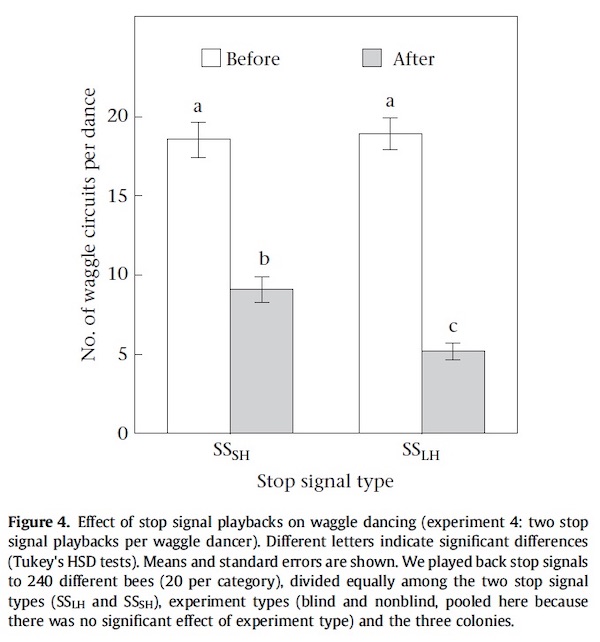
The Asian honey bee, Apis cerana, produces stop signals that referentially encode the threat of different hornet predators. Here we show that artificial playbacks of stop signals generated by bees to communicate the presence of the large, more dangerous hornet (SS LH, Vespa mandarinia) are significantly more inhibitory of waggle dancing than stop signals of the less dangerous smaller hornet (SS SH, Vespa velutina). This inhibition is adaptive because it reduces recruitment to food sources that become dangerous due to a new hornet threat.
Kheradmand, B., Cassano J., Gray, S., and Nieh, J. C. (2018). Influence of visual targets and landmarks on honey bee foraging and waggle dancing. Insect Science. 00, 1-12, DOI 10.1111/1744-7917.12651
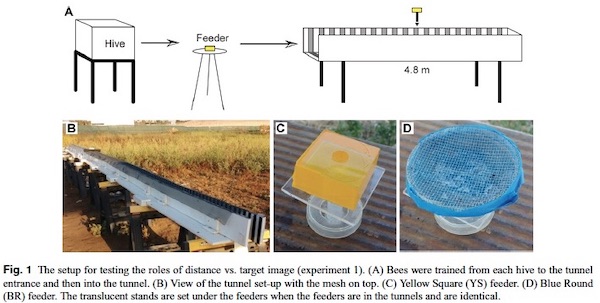
Honey bees, Apis mellifera, are able to learn and remember landmarks and the shapes and colors of flowers to return to rewarding food sources. In this paper, we show that they can prioritize the color and shape of the food source over its remembered distance within a relatively short foraging range. This may help them find similar flowers once the ones they are visiting are depleted of resources such as nectar and pollen.
Gong, Z., Tan, K., and Nieh, J. C. (2018) First demonstration of olfactory learning and long term memory in honey bee queens. The Journal of Experimental Biology. 221:1-10. PMID: 29776994.
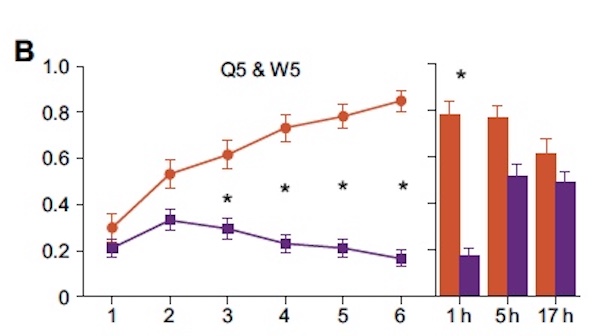
Honey bee queens, Apis mellifera, have excellent learning and memory of odors, even at a very young age, as compared with worker bees. Queens may use odor learning to help guide them back to the nest after their mating flights.
Dong, S., Wen, P., Zhang, Q., Wang, Y., Cheng, Y., Tan, K., and Nieh, J. C. (2018) Olfactory eavesdropping of predator alarm pheromone by sympatric but not allopatric prey. Animal Behaviour. 141: 115-125. https://doi.org/10.1016/j.anbehav.2018.05.013
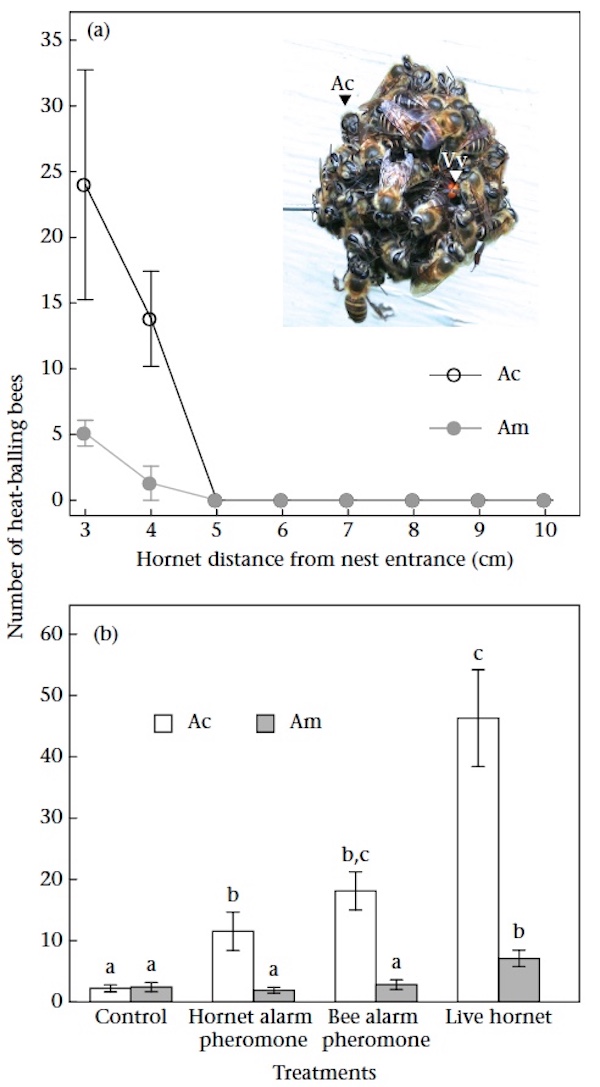
The Asian honey bee species, Apis cerana, can detect and respond with a strong heat-balling defense against its sympatric predator, the hornet Vespa velutina, although the allopatric Western honey bee (Apis mellifera) has only a weak heat-balling defense.
Zhang, J., Wang, Z., Wen, P., Qu, Y., Tan, K., and Nieh, J.C. (2018) The reluctant visitor: an alkaloid in toxic nectar can reduce olfactory learning and memory in Asian honey bees. Journal of Experimental Biology. 221, doi:10.1242/jeb.168344.
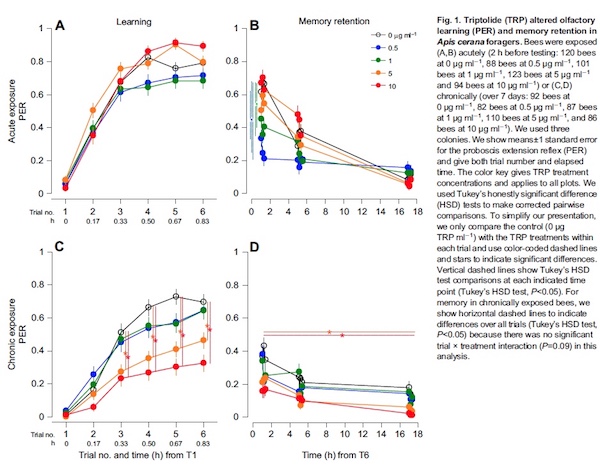
Effects of consuming the natural alkaloid, Triptolide, on honey bee learning and memory.
Tan, K., Wang, C., Dong, S., Li, X., and Nieh, J.C. (2017) The pesticide flupyradifurone impairs olfactory learning in Asian honey bees (Apis cerana) exposed as larvae or as adults. Scientific Reports. 7:17772: DOI:10.1038/s41598-017-18060-z.
The following news articles have been published in the media based upon the Sivanto (flypyradifurone) pesticide exposure paper by Tan et al. (2017). Please download this zipped file for the pdf files.
Tosi, S., Nieh, J. C., Sgolastra, F., Cabbri R., and Medrzycki, P. (2017) Neonicotinoid pesticides and nutritional stress synergistically reduce survival in honey bees. Proceedings of the Royal Society B. 284. 20171711. http://dx.doi.org/10.1098/rspb.2017.1711
To learn more, please see this press release from UCSD. This research was also discussed on the Harry Shearer show (http://harryshearer.com/wp-content/uploads/2017/12/LeShow123117_.mp3): archived version (click here).
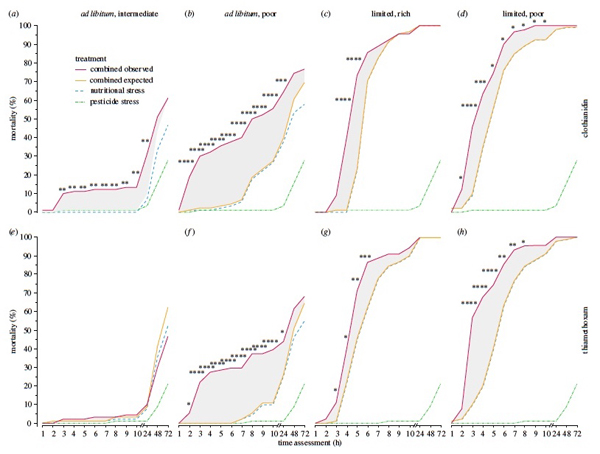
Effects of neonicotinoid exposure and poor nutrition (reduced sugar intake) on honey bee survival.
The following news articles have been published in the media based upon the bee nutrition and pesticide exposure paper by Tosi et al. (2017). Please download this zipped file for the pdf files.
Tosi, S. and Nieh, J. C. (2017) A common neonicotinoid pesticide, thiamethoxam, alters honey bee activity, motor functions, and phototaxis. Scientific Reports. 7: 15132, DOI:10.1038/s41598-017-15308-6
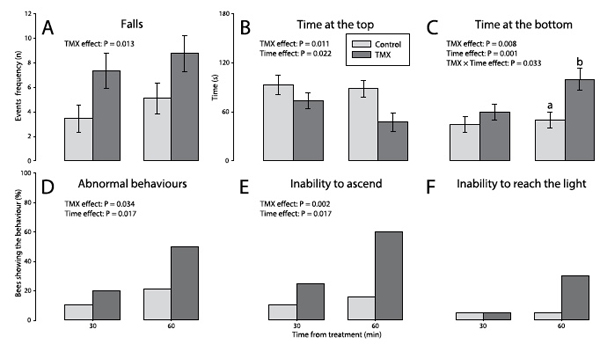
Field-realistic doses of the neonicotinoid pesticide, thiamethoxam, can increase the number of falls in bees walking towards light, increase abnormal behaviors, and alter bee behavior in other ways.
BenVau, L. R., and Nieh, J. C. (2017) Larval honey bees infected with Nosema ceranae have age-accelerated vitellogenin levels as young adults. Scientific Reports. DOI:10.1038/s41598-017-14702-4.
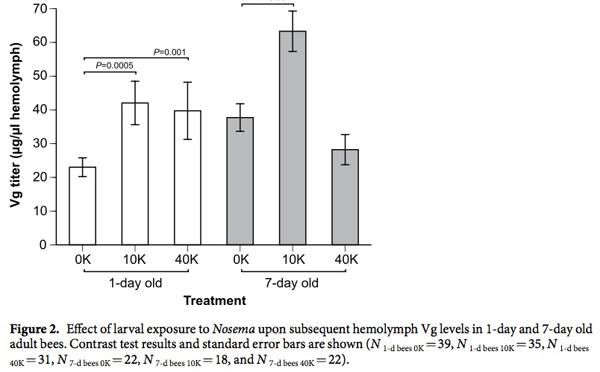
Honey bees that are infected with a common disease, Nosema ceranae, as larvae, show significant changes in vitellogenin, an egg protein that plays a key role in age polyethism and bee health, as young adults.
Ping Wen, Ya-Nan Cheng, Shi-Hao Dong, Zheng-Wei Wang, Ken Tan, James C. Nieh. (2017) Sex pheromone of a globally invasive honey bee predator, the Asian eusocial hornet, Vespa velutina. Scientific Reports. DOI:10.1038/s41598-017-13509-7.
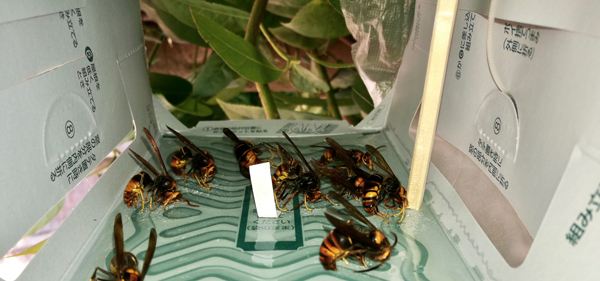
Males of the invasive hornet, Vespa velutina, lured by newly identified and synthesized female sex pheromone into a glue trap.
The following news articles have been published in the media based upon the hornet sex pheromone paper by Wen et al. (2017). Please download this zipped file for the pdf files.
Ping Wen, Yanan Cheng, Yufeng Qu, Hongxia Zhang, Jianjun Li, Heather Bell, Ken Tan, and Nieh, J.C. (2017) Foragers of sympatric Asian honey bee species intercept competitor signals by avoiding benzyl acetate from Apis cerana alarm pheromone. Scientific Reports. DOI:10.1038/s41598-017-03806-6
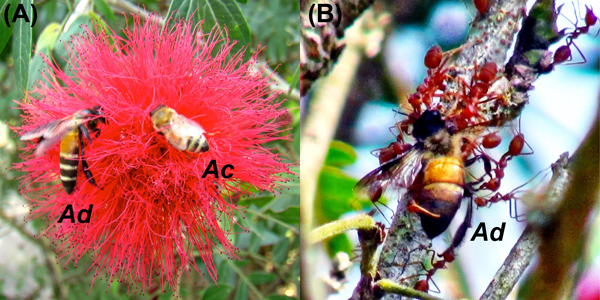
(A) Native Asian honey bee species, Apis dorsata (Ad) and Apis cerana (Ac) foraging on a shared flower. (B) These species are attacked by common predators like ants and it turns out that they can benefit from each other's alarm pheromones, using them to mutually avoid dangerous foraging sites.
Lam, C., Li., Y., Landgraf, T., and Nieh, J.C. (2017) Dancing attraction: followers of honey bee tremble and waggle dances exhibit similar behaviors. Biology Open. 6: 810-817, doi:10.1242/bio.025445
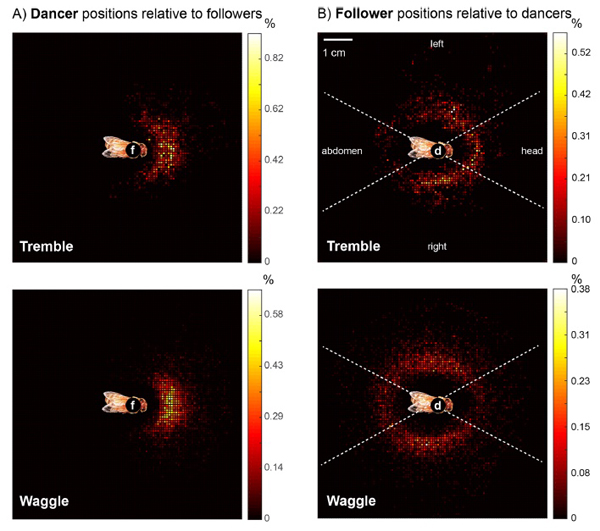
(A) Honey bees communicate with multiple signals of which the waggle dance is perhaps the most famous. In this paper, we show that the receivers of these signals behave similarly when following waggle dances and tremble dances, a signal that occurs in multiple contexts and is related to the reallocation of colony labor.
Ping Wen, Yanan Cheng, Yufeng Qu, Hongxia Zhang, Jianjun Li, Heather Bell, Ken Tan, and Nieh, J.C. (2017) Foragers of sympatric Asian honey bee species intercept competitor signals by avoiding benzyl acetate from Apis cerana alarm pheromone. Scientific Reports. DOI:10.1038/s41598-017-03806-6
(A) Native Asian honey bee species, Apis dorsata (Ad) and Apis cerana (Ac) foraging on a shared flower. (B) These species are attacked by common predators like ants and it turns out that they can benefit from each other's alarm pheromones, using them to mutually avoid dangerous foraging sites.
Park, B. and Nieh, J.C. (2017) The pollen foraging ecology of honey bees (Apis mellifera) in a fragmented environment. Insectes Sociaux. DOI 10.1007/s00040-017-0565-8
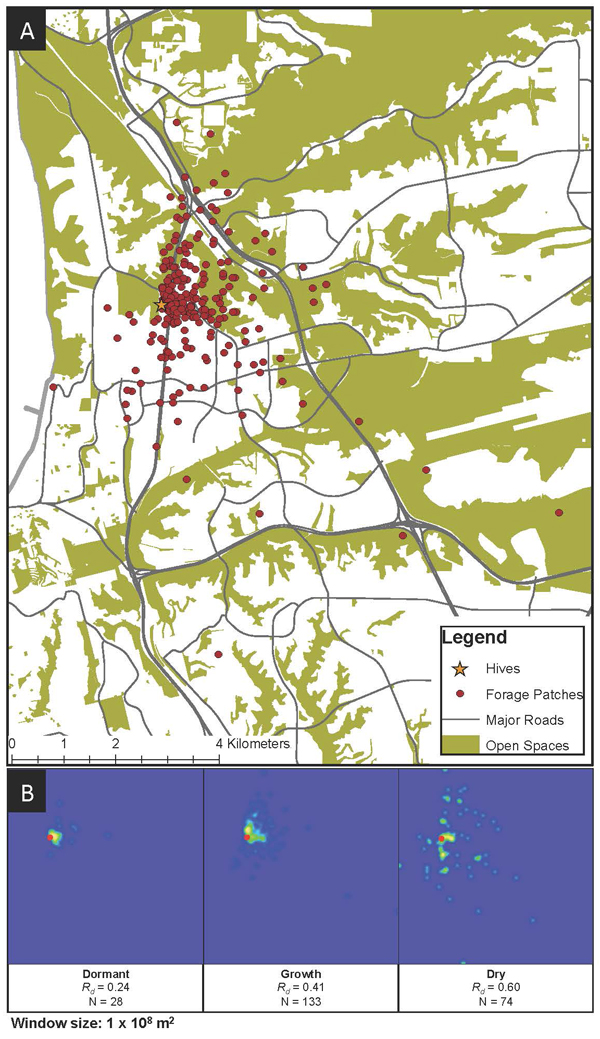
The spatial distribution of bee-visited floral patches inferred from decoding waggle dances. (A) The location of all pollen foraging patches in the study area inferred from the waggle dance plotted onto a land-use map of the study site. White areas indicate developed urban areas. Green areas denote open habitat fragments. Locations of bee foraging patches decoded from waggle dances are denoted by red dots. Observation hives were housed at the location denoted by the orange star. (B) Density maps of bee-visited forage patches decoded from waggle dances for each season. Warmer colors denote a higher density of points at a 100 m 2 spatial resolution. Data was pooled from all colonies (location shown as red dot). This figure was published as Fig. 2 in Park and Nieh (2017).
Tosi, S., G. Burgio, and Nieh, J.C. (2017) Sublethal effects of a common neonicotinoid pesticide, thiamethoxam, on honey bee flight. Scientific Reports. DOI:10.1038/s41598-017-01361-8
Listen the Michigan Public Radio interview of Tosi et al. (2017) .
A press release for Tosi et al. (2017) is available. In addition, this file contains an archive of popular press news articles relevant to this paper.
Tan, K., Dong, S., Liu, X., Wang, C., Li, J., and Nieh J.C. (2016) Honey bee inhibitory signaling is tuned to threat severity and can act as a colony alarm signal. PLOS Biology. 14(3): e1002423-19.
This paper was recenty featured by PLOS Biology in their Open Highlights section: A Swarm of Bee Research by Lauren A. Richardson.
The following news articles have been published in the media based upon Tan et al. (2016). Please download this zipped file for the pdf files.
Tan, K., Cheng, W., Dong, S., Liu, X., Wang, Y. and Nieh, J. C. (2015) A neonicotinoid impairs olfactory learning in Asian honey bees (Apis cerana) exposed as larvae or as adults. Scientific Reports. DOI:10.1038/srep10989.
The following news articles have been published in the media based upon Tan et al. (2015). Please download this zipped file for the pdf files.
Eiri, D., Endler, M., Suwannapong, G., and Nieh, J.C. (2015) Nosema ceranae can infect honey bee larvae and reduce subsequent adult longevity. PLOS One. DOI:10.1371/journal.pone.0126330.
For more information, please listen to a KPBS radio interview about this research at the KPBS website
The following news articles have been published in the media based upon Eiri et al. (2015). Please download this zipped file for the pdf files.
Lichtenberg, E., Graff Zivin, J., Hrncir, M. and Nieh, J. C. (2014) Eavesdropping selects for conspicuous signals. Current Biology. 24(1): R598-R599. DOI: http://dx.doi.org/10.1016/j.cub.2014.05.062
The video below shows how stingless bees can fight for food sources. Fighting makes it costly for eavesdroppers trying to take over food (Lichtenberg et al. 2014).
The following news articles have been published in the media based upon Lichtenberg et al. (2014)
Entomology Today (2014) (pdf archive file) Eavesdropping bees encouraged by "whispers, deterred by "shouts".
Science Recorder (2014) (pdf archive file) Some bees 'shout' to warn would-be competitors.
Eastern Tribune (2014) (pdf archive file) Brazilian bees shout at competitors while pollinating.
American Bee Journal (2014) (pdf archive file) Why ‘whispers’ among bees sometimes evolve into ‘shouts’.
Science World Report (2014) (pdf archive file) Bees ‘shout’ instead of whisper to avoid eavesdroppers.
ScienceBlog (2014) (pdf archive file) Why ‘whispers’ among bees sometimes evolve into ‘shouts’.
Nature World News (2014) (pdf archive file) ‘Whispers’ among bees turn into ‘shouts’
American Live Wire (2014) (pdf archive file) The bee personality: some bees whisper, others shout!
PhysOrg (2014) (pdf archive file) Why ‘whispers’ among bees sometimes evolve into ‘shouts’.
RedOrbit (2014) (pdf archive file) Bee ‘shouts’ warn intruders that a food source will be defended.
Discovery News (2014) (pdf archive file) Some bees shout ‘That nectar’s ours!”
Examiner.com (2014) (pdf archive file) Researcher finds some bees evolved to shout at competitors.
Bray, A. and Nieh, J. C. (2014) PLoS ONE. Non-consumptive predator effects shape honey bee foraging and recruitment dancing. PLoS ONE. 9(1) e87459, DOI: 10.1371/journal.pone.0087459.
New paper. Tan, K., Hu, Z., Chen, W., Wang, Z., Wang, Y., and Nieh, J. C. (2013) Fearful foragers: honey bees tune colony and individual foraging to multi-predator presence and food quality. PLOS ONE. 8(9) e75841, DOI:10.1371/journal.pone.0075841.
The following news articles have been published in the media based upon Tan, K., Hu, Z., Chen, W., Wang, Z., Wang, Y., and Nieh, J. C. (2013)
NatureWorldNews.com (2013) (pdf archive file) Honey bees fear of hornets keeps them away from food sources.
Phys.org (2013) (pdf archive file) Fear of predators drives honey bees away from good food sources.
RedOrbit.com (2013) (pdf archive file) Honeybees avoid food near predatory hotspots.
ScienceDaily.com (2013) (pdf archive file) Fear of predators drives honeybees away from good food sources.
Environmental News Network (2013) (pdf archive file) Fear of predators drives honeybees away from good food sources.
Please note: The copyright of these articles (with the exception of Open Access articles) is with their respective publishers. By downloading an article, you agree to limit the use of the pdf file to printing of single copies for personal research and study. You may not modify the files in any way, or to use them for commercial purposes.
Lau, C. (2012) Ancient Chinese Apiculture. Bee World. December 2012.
Hagbery, J. and Nieh, J. C. (2012) Individual lifetime pollen and nectar foraging preferences in bumble bees. Naturwissenschaften. DOI 10.1007/s00114-012-0964-7. 99:821-832.
Goodale, E. and Nieh, J. C. (2012) Public use of olfactory information associated with predation in two species of social bees. Animal Behaviour. 84:919-924
Eckles, M. A., Roubik, D. W. and Nieh, J. C. (2012) A stingless bee can use visual odometry to estimate both height and distance. Journal of Experimental Biology. 215:3155-3160.
Nieh JC (2012) Animal Behavior: The orphan rebellion. Dispatch for Current Biology 22(8) R280-281
Wade Robinson J, Nieh JC, Goodale E (2012) Testing honey bee avoidance of predators: teaching the scientific process through an engaging field experiment. The American Biology Teacher. 74(7):452-457.
Contrera FAL, Couvillon MJ, Nieh JC (2012)
Editorial: Hymenopteran collective foraging and information transfer about resources. Psyche, Article ID 273985, 2 pages, doi:10.1155/2012/273985Eiri D, Nieh JC (2012) A nicotinic acetylcholine receptor agonist affects honey bee sucrose responsiveness and decreases waggle dancing. Journal of Experimental Biology. 215:2022-2029.
Nguyen H, Nieh JC (2012) Colony and individual forager responses to food quality in the New World bumble bee, Bombus occidentalis. Journal of Insect Behavior. 25:60-69.
Wade Robinson J, Nieh JC, and Goodale E (2011) Pollinators in Peril: A High School Curriculum. Why are bee species disappearing? How can we save species and ourselves? How can we use science to better our world? In this 84 page document, the authors (a high school teacher at San Diego High Tech High, a UCSD faculty member, and a postdoctoral researcher) create a high school science curriculum that addresses three National Science Standards (Inquiry, Life Science, and Science in Personal and Social Perspectives). This single file contains the entire curriculum, including powerpoint presentations. The individual files are also available on Jesse Wade Robinson's website and on the Nieh lab's Teaching Bee website. This project was made possible by a Blasker Science and Technology grant from the San Diego Foundation and partially funded by the National Science Foundation.
Meg Eckles receives a UCSD Excellence in Teaching Award (September 2011) Congratulations to PhD student, Meg Eckles, for receiving a TA Excellence in Teaching Award for her work as a teaching assistant in 2010-2011!
Welcome to visiting Fulbright Scholar, Dr. Guntima Suwannapong (September 2011) Thai professor, Dr. Suwannapong, received a prestigious Fulbright Scholar Award and is conducting research at the Nieh lab for six months on the function of honey bee mandibular gland secretions. This gland is thought to produce an alarm pheromone, but the effects of mandibular gland secretions remain unclear. Dr. Suwannapong has analyzed the chemical contents of honey bee mandibular glands and will be conducting a variety of experiments and bioassays to determine the function of this pheromone.
New research collaboration with Mexican scientists: Effects of the pesticide Spinosad on Mexican bees (August 2011) The title of the project is "Ecological risk assessment: exploring the compatability between the use of Spinosad in agriculture and social pollination by Mexican bees." The Nieh lab is pleased to collaborate with Dr. Daniel Sánchez, El Colegio de La Frontera Sur, Tapachula, Chiapas, Mexico. This project will allow an undergraduate or Masters student to travel and take part in this pesticide research in Mexico.
James Nieh receives 2011 San Diego Science Educator's Association Excellence in University Teaching Award Link to SDSEA website See also This Week@UCSD article by Kim McDonald.
Sanchez, Nieh, & Vandame (2011) Visual and chemical cues provide redundant information in the multimodal recruitment system of the stingless bee Scaptotrigona mexicana (Apidae, Meliponini). Insectes Sociaux: in press.
Video, Television, & Radio
Joyce, E. (2011) "Another pesticide link to vanishing honeybees" KPBS radio broadcast. Listen to the audio recording.
Joyce, E. (2010) "The mystery of vanishing honey bees" KPBS television. Viewable video.
Home and Garden Television, Gardening by the Yard (Episode GBY-1712H) "The Life Cycle of Bees" Season 19. Episode description and photo, but no video link.
Scientific American Frontiers (Calls of the Wild: Bee Lines) "The Life Cycle of Bees" In this early episode, Alan Alda speaks to James Nieh and David Roubik about the recruitment communication of one species of stingless bee in Panama. To view the video, please click on the "Bee Lines" link, the fourth segment in the episode entitled "Calls of the Wild." Viewable video.
Scientific American Frontiers (Calls of the Wild: Bee Lines) "The Life Cycle of Bees" In this early episode, Alan Alda speaks to James Nieh and David Roubik about the recruitment communication of a stingless bee in Panama. This is the link to the show transcript.
University of California Television (first aired 23 February 2009) "Life and death among the flowers" Viewable video.
KPBS Public Radio (21 January 2009) Interview with Maureen Cavanaugh. Listen to the audio recording.
University of California Television (first aired 25 February 2002) "Symbolic communication in stingless bees: exploring the third dimension" Viewable video.
Popular Press & Outreach Archive
Here, we list events, news articles, and public lectures that have occurred and which are related to research conducted in the Nieh lab. We wish to note that the most accurate interpretations of our published research are obtained from the published papers themselves. Statements and claims made in these news articles have not been verified by the paper authors.
Invited Speaker (Oct 10, 2019) Nieh JC. The role of information and decision-making in the evolution of predator and prey signaling between Asian honey bees and hornets. Cornell University, Ithaca, New York.
Invited Speaker (April 25, 2019) Nieh JC. Speaker for TEDx San Diego Mesa College. “Bees & us: an ancient and future symbiosis.” San Diego, California.
Invited Speaker (April 2, 2019) Nieh, JC and Tosi, Simone. Lethal and sublethal synergistic effects of a new systemic pesticide, flupyradifurone (Sivanto) on honey bees. Pacific Branch of the Entomological Society of America Annual Meeting. Symposium speaker: Recent trends in pollinator health and management. San Diego, California, USA.
Panelist (March 9, 2019) Nieh JC. Panel discussion on Marry Fleener's First Graphic Novel, Billie the Bee. San Diego Comic Fest, San Diego, California, USA.
Invited Speaker (February 29, 2019) Nieh JC. The war of nature: eavesdropping social bees and their predators. Yunnan Agricultural University, Kunming, China.
Invited Speaker (February 20, 2019) Nieh JC. A new hope for bee health: immune priming. Chiang Mai University, Thailand.
Invited Speaker (Nov 26, 2018) Nieh JC. Evolution of social insect communication: selective pressures imposed by eavesdropping social bees. Texas A&M, College Station, Texas.
Invited Speaker (Oct 8, 2018) Nieh JC. Nieh JC, “Pesticides and honey bees, a lethal mixture?”, San Diego Beekeepers Assocaiton, San Diego, California.
Invited Speaker (Oct 4, 2018) Nieh JC, What’s up with those bees? Bee health and a new hope. Vi Technology Group, La Jolla, California.
Invited Speaker (August 21, 2018) Nieh JC. Honey bee health: a new approach, immune priming, in an increasingly antibiotic-resistant world. Beijing Bee Research Institute, Chinese Academy of Agricultural Sciences, Beijing, China.
Invited Speaker (May 17, 2018) Nieh JC. Understanding and protecting honey bees. UC San Diego representative and speaker at the Inaugural Understanding and Protecting the Planet Summit.
Guest Lecture: (April 30, 2018) Nieh JC, The problem with pesticides. Lecture given to BILD 18: Human Impact on the Environment, UCSD La Jolla, California.
Interview (April 18, 2018) Nieh JC, Getting Curious with Jonathan Van Ness: How can we be less rude to bees? Los Angeles, California. Download the full interview here.
Workshop Talk: (April 14, 2018) Nieh, JC, Effects of neonicotinoids and flupyradifurone on bees. 36th National Pesticide Forum, Supporting Biodiversity and Balanced Ecosystems, Irvine, California.
Plenary presentation: (April 14, 2018) Nieh, JC, The problem with pesticides: emerging and old xenobiotics. 36th National Pesticide Forum, Organic Neighborhoods: For healthy children, families, and ecology, Irvine, California
UC-Xavier Program 2018-2020: Summer research and graduate training opportunities at UCSD
The lab's research on how pesticides affect honey bees was discussed in this KPBS television segment.
Research seminar: (Jan 19 2018) Nieh JC. CMG Symposium Talk. The milkmaid strategy: Using immune priming to activate honey bee immunity against a common microsporidian pathogen. University of California San Diego, La Jolla, California, USA.
Research seminar: (Nov 20, 2017) Nieh JC. Seminar. The poison-scented pen: alarm, venom, and the evolution of olfactory eavesdropping in highly social bees. University of California Santa Barbara, Santa Barbara, California, USA.
Conference presentation: (Nov. 2017) James C & Nieh JC. The dose makes the poison: honest signaling and aggression in a robber stingless bee, Lestrimelitta niitkib. Entomological Society of America 2017 Conference. Denver, Colorado, USA.
Research seminar: (Oct 23, 2017) Nieh JC. Seminar. Cries in the colony: Honey bee functionally referential communication of danger. University of Arizona, Tuscon, Arizona, USA.
Research seminar: (July 2017) Evolution of referential communication in honey bees: new insights. Yunnan Agricultural Academy, Menzhi, China.
Research seminar: (July 6, 2017) The dose is the poison: evolution of alarm communication in highly social bees. Yunnan Agricultural University, Kunming, Yunnan, China.
Research seminar: (July 4, 2017) Nieh JC. Effects of xenobiotics on the behavior and cognition of honey bees. Xishuangbanna Tropical Botanical Garden, Chinese Academy of Science, Xishuangbanna, China.
Public lecture: (April 18, 2017) Nieh JC, Honey bee health: challenges and hope. Public science lecture for The Bishop’s School, La Jolla, California.
Public lecture: (April 5, 2017) Nieh JC, Honey bee health: food and hope. Torrey Pines Rotary Club, La Jolla, California.
Lab presentation: (Mar 10, 2017) Nieh JC, lab tour for Society of Undergraduate Research and Outreach (SURO) at UCSD for URM high school students and undergraduates. UCSD, La Jolla, California.
Public lecture: (Feb 28, 2017) Nieh JC, Honestly dangerous: Poison and alarm signals in highly social bees. Miramar Community College, San Diego, California.
Public lecture: (Feb 14, 2017) Nieh JC, Honey bees: health and food. Rotary Club, La Jolla, California.
Public lecture: (January 24, 2017) Nieh JC, Honesty is sometimes best: the evolution of alarm communication in bees. Osher Lifelong Learning Institute at UCSD, La Jolla, California.
Public lecture: (November 28, 2016) Nieh JC, An elegant warning: encoding danger and context in the vibrational communication of Asian honey bees. San Diego State University, San Diego, California
Conference presentation (November 15, 2016) Nieh JC, Using immune priming to activate honey bee immunity against Nosema ceranae infection. California State Beekeepers Association Annual Convention 2016, San Diego, California.
Invited academic talk: (November 9, 2016) Nieh JC, University of British Columbia. Referential communication of danger by Asian honey bees.
Invited academic talk: (Oct 17, 2016) Nieh JC. University of Kentucky. Cries in the hive: encoding danger and context in the referential communication of Asian honey bees.
Conference presentation: (September 30, 2016) Nieh JC. International Congress of Entomology. Effects of a new pesticide, flupyradifurone (Sivanto), on honey bee sucrose response thresholds and orientation.
Conference presentation: (September 24, 2016) Nieh JC. IUSSI NAS Breakout Meeting. A honey bee inhibitory signal provides referential information about predator threat and can act as a colony alarm signal.
Public lecture: (July 11, 2016) Nieh, JC, Presentation: Honey bee health: What’s up with pesticides and bee diseases? San Diego Beekeeper’s Assocation, Balboa Park, Casa del Prado, Room 101.
Public lecture: (June 8, 2016) Nieh, JC, Presentation: Honey bee health: food, life, and love. University of San Diego, University of the Third Age, Community Outreach.
Public lecture: (May 14, 2016) Nieh, JC, Presentation: The conundrum of modern agriculture: pesticide effects on honey bees. No bees, no food campaign by Environment America.
Lecture: (Feb 25, 2016) Nieh, JC, Presentation on honey bee health and declines to the UCSD Pre-Veterinary Student Association.
Undergraduate Honors Seminar: (Fall 2015) Nieh JC, Healing honey bees: how basic research can translate into practical solutions. Muir College Honors Seminar, UCSD, La Jolla, California.
Public lecture: (Nov 17, 2015) Nieh JC, Activating honey bee immunity against Nosema ceranae infection. California State Beekeeper's Association, Sacramento, California.
Public lecture: (Nov 13, 2015) Nieh JC, Sublethal pesticide effects on honey bee behavior. Pennsylvania Beekeeper’s Annual Conference, Pennsylvania State Beekeepers’ Association, Lewisburg, Pennsylvania.
Public lecture: (June 19, 2015, exact date to be determined) Nieh JC, Honey bee health: diseases and pesticides. Seminar at the Center for Scientific Research and Higher Education, Ensenada, Baja California, Mexico (CICESE).
Public lecture: (May 14, 2015) Nieh JC. The effects of neonicotinoid pesticides on honey bee behavior. Seminar at El Colegio de la Frontera Sur, Tapachula, Chiapas, Mexico.
Public lecture: (April 24, 2015) Nieh JC, Shaped by danger: How honey bee foraging and communication respond to predators and are shaped by eavesdropping and inhibitory signaling. Joint BEACON and Entomology Seminar. Michigan State University, Michigan, USA.
Honey Bee Online Studies (HOBOS) for teaching (2015) The Nieh lab has now partnered with HOBOS to provide more teaching resources (available in English or German) that teach the scientific method and the importance of honey bees. HOBOS complements the Teaching Bee.
Teaching Bee Exercises and Videos (2015) Exercises and videos from the Teaching Bee are now available and permanently archived at the UCSD Library's digital collections. These items are designed to teach the scientific method and the importance of bees as pollinators. They are for students and teachers at multiple levels (elementary-college) and are also on the Teaching Bee website, but the UCSD library will provide a permanent archive that we also hope will attract more users.
Public lecture: (April 29, 2014) Nieh JC, The conundrum of honey bee health. Osher Lifelong Learning Institute at UCSD, La Jolla, California.
New UCSD Freshman Seminar (Winter Quarter 2014) Nieh JC, "Saving the bees: the science behind bee declines and what you can do about it." Many species of bees, including honey bees, face declines due to multiple factors. We will learn the latest scientific research on these problems and design innovative ways to improve public awareness and deal with these issues. Students with the best practical ideas and inventions will be encouraged to implement them in subsequent quarters. Seminar for UCSD Freshman. UCSD, La Jolla, California, USA.
Public lecture: (Oct 1, 2013) Nieh JC, Risky business: effects of neonicotinoid pesticides on bee behavior. Orange County Beekeeper’s Association, Orange County, California.
Departmental seminar: (Sept 25, 2013) Nieh JC, Hazards of pollination: the honey bee dance language tells us about foraging dangers, natural and man-made. Seminar. Howard University, Washington DC, USA.
Panel discussion: (June 23, 2013) Tosi, Simone, Panelist for discussion on honey bees and bee health at Whole Foods Market, La Jolla, California
Public lecture: (June 22, 2013) Nieh JC, "Shaking up the hive: honey bees produce a special signal in response to danger." New Mexico Beekeeper’s Association Mid-Year Meeting, Albuquerque, New Mexico
Public lecture: (June 22, 2013) Nieh JC, "Challenges to honey bee health: effects of a neonicotinoid pesticide and Nosema ceranae infection. New Mexico Beekeeper’s Association Mid-Year Meeting, Albuquerque, New Mexico.
Panel discussion: (May 31, 2013) Nieh JC, Panelist for discussion following movie screening of “More than Honey” by Markus Imhoof, by the Santa Barbara Beekeeping Association, Santa Barbara, California.
Public lecture: (May 23, 2013) Nieh JC, Effects of neonicotinoid pesticides on honey bees. Beekeepers Association of Southern California, La Mirada, California.
Public lecture: (May 7, 2013) Nieh JC, Effects of Nosema cerana infection on honey bee larvae. Orange County Beekeeper’s Association, Orange County, California.
Public lecture: (March 24, 2013) Nieh JC, Lecture and presentation on honey bee biology, diseases, and health as part of the UCSD Alumni Association and the San Diego Science and Engineering Fair at Wild Willow Farm and Education Center, San Diego, California.
Public lecture: "Risky business: effects of predators and pesticide on bee foraging communication" (May 6, 2013) Nieh JC, Seminar. University of California Santa Barbara.
Public lecture: "Silent Spring + 50: Lessons from San Diego’s Bees and Bays": The Silent Spring Series: Exploring Ethics." The research featured in this lecture is the work of Daren Eiri, whose Master's thesis was based upon the effects of Imidacloprid and who subsequently tested the hypothesis that Nosema ceranae can infect honey bees.
Public lecture: "What’s up with those bees? Honey bee declines and disease” (Jan 17, 2013) for the San Diego Science Educators Association, San Diego. Please contact SDSEA for more information.
Public lecture on honey bee health and the fungal pathogen, Nosema. (Nov 15, 2012) California State Beekeepers Association Convention, Palm Springs, California.
Lecture on bee eavesdropping and espionage. (Sept 26, 2012) CSU Fullerton for the Southern California Ecosystems Research Project.
Essential pollinators: learn about native bees and honey bees.” (June 23, 2012) Balboa Park, Casa Del Prado, San Diego, California for San Diego Pollinator Week.
The great bee die-off: a crisis of colony health and contamination (April 12, 2012), Rancho Santa Fe Garden Club, Rancho Santa Fe, California.
Welcome to the mysterious world of bees (February 27, 2012) International House at UCSD will be hosting a free event open to the public at which clips from the movie "Queen of the Sun" will be shown. James Nieh will be one of the speakers at this event, which will also include other speakers: a visiting Thai Fulbright Professor, Dr. Guntima Suwannapong, and the Vice President of the San Diego Beekeeping Society, Eric Robinson. There will also be a local honey tasting! This event is brought to you by IAG, Slow Food Urban San Diego, The San Diego Beekeeping Society, Slow Food UCSD, Garden of Eden Organics, and the SSC.
The following news articles have been published in the media based upon Eiri and Nieh (2012) and a UCSD press release issued for this paper. Statements and claims made in these news articles have not been verified by D. Eiri or J. Nieh.
Mongabay.com (2012) (pdf archive file) After damning research, France proposes banning pesticide linked to bee collapse.
NSF (2012) (pdf archive file) Crop pesticide's impact on honey bees (NSF news).
wired.com (2012) (pdf archive file) Pesticides make honeybees picky eaters and reluctant dancers (Wired UK).
MailOnline (2012) (pdf archive file) Pesticide kills bee colonies by turning insects into ‘picky eaters’ who crave sweeter nectar - and ignore nearby food.
redorbit.com (2012) (pdf archive file) Pesticide Turns Bees Into Picky Eaters - Science News.
sciencedaily.com (2012) (pdf archive file) Commonly used pesticide turns honey bees into ‘picky eaters'.
westernfarmpress.com (2012) (pdf archive file) Pesticide affects honey bee feeding habits.
beyondpesticides.org (2012) (pdf archive file) Beyond Pesticides Daily News Blog » Blog Archive » Research Shows Imidacloprid Depresses Honey Bee Feeding and Communication.
enewspf.com (2012) (pdf archive file) Research Shows Imidacloprid Depresses Honey Bee Feeding and Communication.
esciencenews.com (2012) (pdf archive file) Commonly used pesticide turns honey bees into ‘picky eaters’.
phys.org (2012) (pdf archive file) Commonly used pesticide turns honey bees into ‘picky eaters’.
wildlifenews.co.uk (2012) (pdf archive file) Common pesticide gives bees a sweet-tooth.
scientias.nl (2012) (pdf archive file) Bestrijdingsmiddel maakt honingbij tot een kieskeurige eter.
tech.money.pl (2012) (pdf archive file) Pestycyd sprawia, że pszczoły stają się wybredne.
tw.news.yahoo.com (2012) (pdf archive file) Pesticides make bees 'picky eaters' (Chinese language publication).
Pat Ledden Memorial Luncheon Talk (December 1, 2011) "Perils of pollination: warning cries inside the hive", Upcoming lecture. Location: Ida and Cecil Green Faculty Club, UCSD Campus, La Jolla, California, (time to be announced).
Idyllwild Garden Club Talk (October 22, 2011) "What's up with those bees?" Upcoming lecture. Location: Caine Learing Center, Idyllwild, California (9:00-10:00 am).
UCSD Emerti Association Talk (October 12, 2011) "Pollinators in peril: factors behind honey bee declines" Upcoming lecture. Location: Ida and Cecil Green Faculty Club, UCSD Campus, La Jolla, California (3:30-5:00 pm).
San Diego Master Gardener's Association (24 May 2011) " Pollinators in peril" Upcoming lecture. This is largely similar in content to the lecture that I gave on the 19 April 2011 (see below). Location: Balboa Park, Casa Del Prado, Room 101, 9-10 am.
Perspectives on Science, Point Loma Nazarene University (3 May 2011) "The secret lives of bees" Upcoming lecture. This lecture will focus on the biology and communication of bees, particularly honey bees and stingless bees. At the end, there will be a brief discussion of bee declines that is similar to the information provided in previous presentations I have given this year.
Lecture Reprise (29 April 2011). In case you missed the lecture that I gave earlier this week on the "Decline and Fall of Bees: Pollinators in Peril" (see below), I will also be giving it to an undergraduate student class at UCSD in Solis Hall Room Room 107 on 4/29/11 from noon to 1 pm. This is the same lecture. If you are not a UCSD student but would like to attend, please email the instructor (msaier@ucsd.edu) for permission.
UCSD Biomedical Library Talk (19 April 2011) "Decline and fall of bees: pollinators in peril" Listen to the audio recording and view the slides. As a clarification, I would like to add that although it is possible to find individuals to remove swarms for free, removal of colonies inside buildings requires qualified individuals and, depending upon the difficulty of the removal, will cost varying amounts. A good resource for San Diegans is provided by the San Diego Beekeeping Society. Here is a list of people who can help you out.
Food Justice Forum (16 April 2011) Food Justice Forum Cultivating University-Community Partnerships for a Healthier Society. See also: "Food Justice Forum a Success at The Global Arc.
Anonymous (2010) "Bees use a stop signal to warn nestmates of danger" BBC News Big Picture
Reilly, M. (2010) "Bees can say stop" Discovery News, Animal Planet
A. N. I. (2010) "Stop signal in honey bee communication discovered by biologist" Science News
Braun (2010) "Bees butt waggle dancers when danger lurks" National Geographic, NatGeo News Watch
LaFee (2010) "Hives stayin' alive: dancing bees' 'stop signal' warns of peril, UCSD researcher says" San Diego Union Tribune
UCSD (2010) " Biologist discovers ‘stop’ signal in honey bee communication"
Hadley, D. (2010) " Threatened honey bees tell others to 'Stop dancing!'" About.com: Insects
Soos, A. (2010) "The Language of Bees" Environmental News Network
Schoolcraft (2010) "Butting bees say 'stop'" Springfield Plateau
Anonymous (2009) " Warm Bee Food" The New York Times Science in Pictures
Anonymous (2009) "Hot for teacher" ScienceShots
Brown S (2008) "Wasps and Bumble Bees Heat Up, Fly Faster With Protein-Rich Food"
Phillips K (2008) "Pollen makes bees hot" (with cartoon!) The Journal of Experimental Biology 2008: iii
Walsh P (2006-2007) " ORBS Receives Funding from NSF" BioSphere 2006-2007: 26
Walsh P (2005) " UCSD Biological Sciences: hooking kids (and grownups) on science" BioSphere Fall: 26
Rowe P (2005) " How do you get from point A to point Bee?" San Diego Union-Tribune 17 July: E2
Pearlman I (2004/05) " Beehive in Muir is stage for interpretive dance performance" BioSphere Winter: 10-11
Fusaro K (2004) Espionagem entra abelhas. In: Pesquisa FAPESP
Leite M (2004) Guerra de abelhas por néctar tem até espiões e linguagem em código. In: Folha de S. Paulo, São Paulo
Milius S (2004) Trail mix: espionage among the bees. Science News 166
Webb S (2004) Honeybees' espionage mission. In: Discover, vol 25, pp 17
Nieh JC (2003) Abelhinhas espertas. Fundação de Amparo à Pesquisa do Estado de São Paulo
Ristine J (2002) " UCSD researcher learning the buzzword of beespeak". San Diego Union-Tribune 18 Feb.: B1
Thomson J (2000) Food vibrations. In: Nature science update
Milius S (1999) Look who's dancing. In: Science News, vol 155, pp 216-218

