Oliver Ryder
Research
Challenges involved in conserving biological diversity include addressing the numerous scientific issues limiting our understanding of the Earth's biota. Speciation and species diversity, the role of genetic variation in population persistence, its rate of generation and loss in different taxonomic groups and under different ecological conditions, as well as the development of tools for addressing these questions are all significant topics in biology pertinent to conservation issues. The genetics group at the CRES (Center for Reproduction of Endangered Species - a division of the Zoological Society of San Diego) undertakes comparative cytogenetic and molecular genetics studies involving a diverse array of species suitable as models for investigating relative rates of evolution among different taxa, population structure and systematics. Additionally, research pertinent to planning and management for selected mammalian, reptilian and avian species of conservation concern is undertaken utilizing appropriate techniques, including the development and application of new methodologies. Current emphases include molecular evolutionary and population studies involving analysis of nuclear microsatellite allelic variation and nucleotide sequence analysis of mitochondrial genomes. Assessment, planning, monitoring, and management of small populations for conservation will benefit from application of more effective methods of collection and analysis of genetic data.
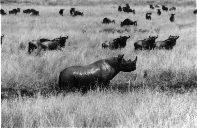
Black rhinoceros male in Masia Mara Reserve in Kenya. Increased knowledge of genetics of black rhinos contributes to monitoring and recovery efforts for this endangered species.
An increased understanding of many threatened species at the cytogenetic and molecular genetic level will contribute to gene pool conservation strategies and management as well as establishing a broader knowledge of the dynamics of genome evolution. Located in lab facilities on the grounds of the San Diego Zoo, our studies are facilitated by unique resources, including cell lines and other biological samples that are available as a result of the animal collections of the San Diego Zoo and Wild Animal Park as well as through associated field activities of CRES staff.
Select Publications
- Ivy, J.A., A.S. Putnam, A.Y. Navarro, J. Gurr, and O.A. Ryder. 2016. Applying SNP-derived molecular ancestry estimates to captive breeding programs. Journal of Heredity 107(5). 403-412.
- Saragusty, J., S. Diecke, M. Drukker, B.S. Durrant, I.F. Ben-Nun, C. Galli, F. Goritz, K. Hayashi, R. Hermes, S. Holtze, S. Johnson, G. Lazzari, P. Loi, J.F. Loring, K. Okita, M.B. Renfree, S. Seet, T. Voracek, J. Stejskal, O.A. Ryder, and T.B. Hildebrandt. 2016. Rewinding the Process of Mammalian Extinction. Zoo Biology 9999. 1-13.
- Yu, L., G-D. Wang, J. Ruan, Y-B. Chen, C-P. Yang, X. Cao, H. Wu, Y-H. Liu, Z-L. Du, X-P. Wang, J. Yang, S-C. Cheng, L. Zhong, L. Wang, X. Wang, J-Y. Hu, L. Fang, B. Bai, K-L. Wang, N. Yuan, S-F. Wu, B-G. Li, J-G. Zhang, Y-Q. Yang, C-L. Zhang, Y-C. Long, H-S. Li, J-Y. Yang, D.M. Irwin, O.A. Ryder, Y. Li, C-I. Wu, and Y-P. Zhang. 2016. Genomic analysis of snub-nosed monkeys (Rhinopithecus) identifies genes and processes related to high-altitude adaptation. Nature Genetics 48(8). 947-955.
- Bosse, M., H-J. Megens, O. Madsen, R.P.M.A. Crooijmans, O.A. Ryder, F. Austerlitz, M.A.M. Groenen, and M.A.R. de Cara. 2015. Using genome-wide measures of coancestry to maintain diversity and fitness in endangered and domestic pig populations. Genome Research 25. 970-981.
- Buchalski, M.R., A.Y. Navarro, W.M. Boyce, T. Winston Vickers, M.W. Tobler, L.A. Nordstrom, J.A. Garcia, D.A. Gille, M.C.T. Penedo, O.A. Ryder, and H.B. Ernest. 2015. Genetic population structure of Peninsular bighorn sheep (Ovis canadensis nelsoni) indicates substantial gene flow across US–Mexico border. Biological Conservation 184. 218-228.
- Fisch, K.M., C.C. Kozfkay, J.A. Ivy, and O.A. Ryder. 2015. Fish hatchery genetic management techniques: Integrating theory with implementation. North American Journal of Aquaculture 77. 343-357.
- Koepfli, K.-P., B. Paten, The Genome 10K Community of Scientists, C. Steiner, O. Ryder, and S.J. O’Brien. 2015. The genome 10K project: A way forward. Annual Review of Animal Biosciences 3. 57-111.
- Nam, K., K. Munch, A. Hobolth, J.Y. Dutheil, K.R. Veeramah, A.E. Woerner, M.F. Hammer, Great Ape Genome Diversity Project, O.A. Ryder, T. Mailund, and M.H. Schierup. 2015. Extreme selective sweeps independently targeted the X chromosomes of the great apes. Proceedings of the National Academy of Sciences 112. 6413-6418.
- Steiner, C.C., S.J. Charter, N. Goddard, H. Davis, M. Brandt, M.L. Houck, and O.A. Ryder. 2015. Chromosomal variation and perinatal mortality in San Diego Zoo Soemmerring’s gazelles. Zoo Biology 9999. 1-11.
- Wisely, S.M., O.A. Ryder, J.F. Santymire, Engelhardt, and B.J. Novak. 2015. A road map for 21st century genetic restoration: Gene pool enrichment of the black-footed ferret. Journal of Heredity 106. 581-592.
- Liu, J., X. Wang, S. Cho, B.K. Lim, D.M. Irwin, O.A. Ryder, Y. Zhang, and L. Yu. 2014. Evolutionary and functional novelty of pancreatic ribonuclease: A study of Musteloidea (order Carnivora). . Scientific Reports. DOI: 10.1038/srep05070.
- O’Brien, S.J., D. Haussler, and O.A. Ryder. 2014. The birds of Genome10K. GigaScience 3. 32.
- Steiner, C.C., S.J. Charter, M.L. Houck, and O.A. Ryder. 2014. Molecular phylogeny and chromosomal evolution of Alcelaphini (Antilopinae). Journal of Heredity 105. 324-333.
- Evans, J.D., S.J. Brown, K.J. Hackett, G. Robinson, S. Richards, D. Lawson, C. Elsik, J. Coddington, O. Edwards, S. Emrich, T. Gabaldon, M. Goldsmith, G. Hanes, B. Misof, M. Munoz-Torres, O. Niehuis, A. Papanicolaou, M. Pfrender, M. Poelchau, M. Purcell-Miramontes, H.M. Robertson, O.A. Ryder, D. Tagu, T. Torres, E. Zdobnov, G. Zhang, and X. Zhou. 2013. The i5K Initiative: Advancing arthropod genomics for knowledge, human health, agriculture, and the environment. Journal of Heredity 104. 594-600.
- Luan, P.-T., O.A Ryder, H. Davis, Y.-P. Zhang, and L. Yu. 2013. Incorporating indels as phylogenetic characters: Impact for interfamilial relationships within Arctoidea (Mammalia: Carnivora). . Molecular Phylogenetics and Evolution 66. 748–756.
- Moser, A.B., J. Hey, P.K. Dranchak, M.W. Karaman, J. Zhao, L.A. Cox, O.A. Ryder, and J.G. Hacia. 2013. Diverse captive non-human primates with phytanic acid-deficient diets rich in plant products have substantial phytanic acid levels in their red blood cells. Lipids in Health and Disease. DOI: 10.1186/1476-511X-12-10.
- Orlando, L., A. Ginolhac, G. Zhang, D. Froese, A. Albrechtsen, M. Stiller, M. Schubert, E. Cappellini, B. Petersen, I. Moltke, P.L. Johnson, M. Fumagalli, J.T. Vilstrup, M. Raghavan, T. Korneliussen, A.S. Malaspinas, J. Vogt, D. Szklarczyk, C.D. Kelstrup, J. Vinther, A. Dolocan, J. Stenderup, A.M. Velazquez, J. Cahill, M. Rasmussen, X. Wang, J. Min, G.D. Zazula, A. Seguin-Orlando, C. Mortensen, K. Magnussen, J.F. Thompson, J. Weinstock, K. Gregersen, K.H. Roed, V. Eisenmann, C.J. Rubin, D.C. Miller, D.F. Antcza, M.F. Bertelsen, S. Brunak, K.A. Al-Rasheid, O.A. Ryder, L. Andersson, J. Mundy, A. Krogh, M.T. Gilbert, K. Kjær, T. Sicheritz-Ponten, L.J. Jensen, J.V. Olsen, M. Hofreiter, R. Nielsen, B. Shapiro, J. Wang, and E. Willerslev. 2013. Recalibrating Equus evolution using the genome sequence of an early Middle Pleistocene horse. Nature 499. 74-78.
- Prado-Martinez, J., P.H. Sudmant, J.M. Kidd, H. Li, J.L. Kelley, B. Lorente-Galdos, K.R. Veeramah, A.E. Woerner, T.D. O’Connor, G. Santpere, A. Cagan, C. Theunert, F. Casals, H. Laayouni, K. Munch, A. Hobolth, A.E. Halager, M. Malig, J. Hernandez-Rodriguez, I. Hernando-Herraez, K. Prufer, M. Pybus, L. Johnstone, M. Lachmann, C. Alkan, D. Twigg, N. Petit, C. Baker, F. Hormozdiari, M. Fernandez-Callejo, M. Dabad, M.L. Wilson, L. Stevison, C. Camprubí, T. Carvalho, A. Ruiz-Herrera, L. Vives, M. Mele, T. Abello, I. Kondova, R.E. Bontrop, A. Bontrop, F. Lankester, J.A. Kiyang, R.A. Bergl, E. Lonsdorf, S. Myers, M. Ventura, P. Gagneux, D. Comas, H. Siegismund, J. Blanc, L. Agueda-Calpena, M. Gut, L. Fulton, S.A. Tishkoff, J.C. Mullikin, R.K. Wilson, I.G. Gut, M.K. Gonder, O.A. Ryder, B.H. Hahn, A. Navarro, J.M. Akey, J. Bertranpetit, D. Reich, T. Mailund, M.H. Schierup, C. Hvilsom, A.M. Andres, J.D. Wall, C.D. Bustamante, M.F. Hammer, E.E. Eichler, and T. Marques-Bonet. 2013. Great ape genetic diversity and population history. Nature 499. 471-475.
- Steiner, C.C, and O.A. Ryder. 2013. Characterization of Prdm9 in equids and sterility in mules. PLoS One 8. e61746.
- Steiner, C.C, A.S. Putnma, P.E.A. Hoeck, and O.A. Ryder. 2013. Conservation genomics of threatened animal species. Annual Review of Animal Biosciences 1. 261-281.
- Bernardi, G., E.O. Wiley, H. Mansour, M.R. Miller, G. Orti, D. Haussler, S.J. O’Brien, O.A. Ryder, and B. Venkatesh. 2012. The fishes of Genome 10K. Marine Genomics 7. 3-6.
- Dennis, P., S. Ellis, J. Mellen, P. Lee, F. Olea-Popelka, A. Petric, and O.A. Ryder. 2012. IOD in rhinos--epidemiology group report: Report from the epidemiology working group of the international workshop on iron overload disorder in browsing rhinoceros (February 2011). . Journal of Zoo and Wildlife Medicine 43. 114-116.
- Frankham, R., J.D. Ballou, M.R. Dudash, M.D.B. Eldridge, C.B. Fenster, R.C. Lacy, J.R. Mendelson, I.J. Porton, K. Ralls, and O.A. Ryder. 2012. Implications of different species concepts for conserving biodiversity. . Biological Conservation 153. 25-31.
- McCue, M.E., D.L. Bannasch, J.L. Petersen, J. Gurr, E. Bailey, M.M Binns, O. Distl, G. Guerin, T. Hasegawa, E.W. Hill, T. Leeb, G. Lindgren, M.C.T. Penedo, K.H. Roed, O.A. Ryder, J.E. Swinburne, T. Tozaki, S.J. Valberg, M. Vaudin, K. Lindblad-Toh, C.M. Wade, and J.R. Mickelson. 2012. A high density SNP array for the domestic horse and extant Perissodactyla: Utility for association mapping, genetic diversity, and phylogeny studies. PLoS Genetics 8. e1002451.
- Ryder, O.A. 2012. The Frozen Zoo. GeneWatch 25. 19-20.
- Scally, A., J.Y. Dutheil, L.W. Hillier, G.E. Jordan, I. Goodhead, J. Herrero, A. Hobolth, T. Lappalainen, T. Mailund, T. Marques-Bonet, S. McCarthy, S.H. Montgomery, P.C. Schwalie, Y.A. Tang, M.C. Ward, Y. Xue, B. Yngvadottir, C. Alkan, L.N. Andersen, Q. Ayub, E.V. Ball, K. Beal, B.J. Bradley, Y. Chen, C.M. Clee, S. Fitzgerald, T.A. Graves, Y. Gu, P. Heath, A. Heger, E. Karakoc, A. Kolb-Kokocinski, G.K. Laird, G. Lunter, S. Meader, M. Mort, J.C. Mullikin, K. Munch, T.D. O’Connor, A.D. Phillips, J. Prado-Martinez, A.S. Rogers, S. Sajjadian, D. Schmidt, K. Shaw, J.T. Simpson, P.D. Stenson, D.J. Turner, L. Vigilan, A.J. Vilella, W. Whitener, B. Zhu, D.N. Cooper, P. de Jong, E.T. Dermitzakis, E.E. Eichler, P. Flicek, N. Goldman, N.I. Mundy, Z. Ning, D.T. Odom, C.P. Ponting, M.A. Quail, O.A. Ryder, S.M. Searle, W.C. Warren, R.K. Wilson, M.H. Schierup, J. Rogers, C. Tyler-Smith, and R. Durbin. 2012. Insights into hominid evolution from the gorilla genome sequence. Nature 483. 169-175.
- Field, D., Chemnick, L., Robbins, M., Garner, K. and Ryder, O.A. (1998). Paternity determination in captive lowland gorillas and orangutans and wild mountain gorillas by microsatellite analysis. Primates 39:199-209.
- Burrows, W. and Ryder, O.A. (1997). Y-chromosome variation in great apes. Nature 385:125-126.
- Garner, K.J. and Ryder, O.A. (1996). Mitochondrial DNA diversity in gorillas. Molec. Phyl. Evol. (In press).
- Zhang, Y. and Ryder, O.A. (1995). Different rates of mitochondrial DNA sequence evolution in Kirk's dik-dik (Madoqua kirkii) populations. Mol. Phyl. Evol. 4:291-297.
- Ryder, O. A. and Feistner, A.T.C. (1995). Research in zoos: a growth area in conservation. Biodiversity and Conservation 4: 671-677.
- Zhang, Y. and Ryder, O.A. (1993). Mitochondrial DNA sequence evolution in the Arctoidea. Proc. Natl. Acad. Sci. USA 90: 9557-9561.
Biography
Oliver A. Ryder received his Ph.D. from UCSD. He is the geneticist and recipient of the Kleberg Genetics Chair at the Center for Reproduction of Endangered Species, Zoological Society of San Diego. He is a member of Specialist Groups of the Species Survival Commission of World Conservation Union: Equid Specialist Group, Captive Breeding Specialist Group, and Re-introduction Specialists Group. Dr. Ryder is an associate editor of the Journal of Heredity.